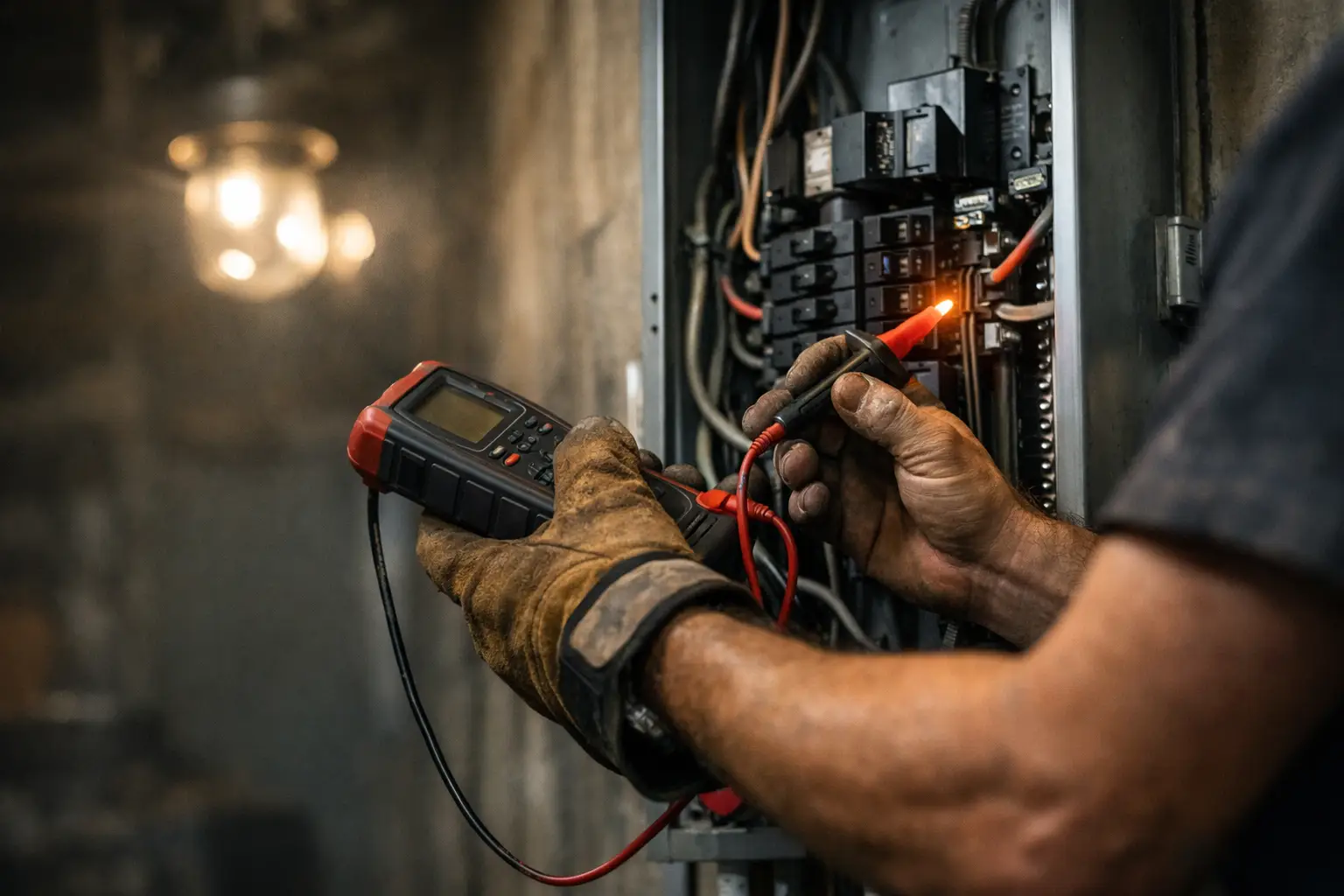
A light that flickers in just one room gets your attention fast, especially when the rest of the house looks normal. If you are dealing with flickering lights in one room, that usually points to a local problem, not a whole-house power issue. That is good news in the sense that the trouble is often easier to isolate. It is not good news if the cause is a loose electrical connection hiding in a switch box, fixture box, or branch circuit splice.
The main question is simple: is the problem at the light itself, or somewhere upstream on that room’s circuit? That distinction matters, because one points to a relatively contained repair and the other may point to wiring, breaker, or connection problems that need a licensed electrician to track down properly.
What flickering lights in one room usually mean
When only one room is affected, the problem is usually tied to one of five things: a failing light fixture, a bad switch, a loose neutral or hot connection, an overloaded branch circuit, or voltage drop caused by something else sharing that circuit.
A bad bulb can still be the culprit, but homeowners usually check that first. If you have already swapped the bulb and the flicker stays, move your attention to the parts around it. Recessed lights, older ceiling fixtures, worn dimmers, and backstabbed switches are common trouble spots in houses around Huntsville, Madison, and Harvest, especially in homes that have seen partial remodels over the years.
The pattern of the flicker tells you a lot. If one fixture flickers but the lamps or receptacles in that room do not, the issue may be confined to that fixture or switch. If multiple lights in the same room flicker together, especially with no obvious pattern, that starts sounding more like a shared circuit or connection problem.
Start with the pattern, not the panic
Before anybody opens a box, pay attention to what the lights are doing.
If the flicker happens only when a vacuum, space heater, microwave, hair dryer, or portable AC kicks on, you may be dealing with a loaded circuit or a voltage drop issue. That does not automatically mean the house is dangerous, but it does mean the circuit may be undersized for how the room is being used now.
If the lights flicker randomly with no appliance turning on, that is more concerning. Random flicker often points to a failing switch, loose connection, or worn fixture component. If the light gets brighter and dimmer instead of simply blinking, a loose neutral becomes more likely, and that is not something to ignore.
If dimmable lights are involved, the dimmer itself may be the problem. Older dimmers often do not play well with newer LED lamps. You can get buzzing, strobing, or intermittent flicker even when the wiring is technically intact. That is one of those cases where the symptom looks serious but the fix may be straightforward once the correct dimmer and lamp type are matched.
A few safe checks a homeowner can make
There are some useful observations you can make without getting into live electrical work.
First, try a known-good bulb of the correct type and wattage. If the fixture uses LEDs, make sure the lamp is dimmer-compatible if it is controlled by a dimmer. Cheap LEDs cause plenty of nuisance flicker, and it can waste a lot of time if nobody rules that out first.
Second, check whether other lights or receptacles in the same room are acting up. Plug a lamp into an outlet in that room and see if it flickers along with the ceiling light. If both do it, the issue is probably not the fixture alone.
Third, notice whether the flicker changes when you touch the switch, run a fan, or turn on another load nearby. A switch that feels warm, makes a faint crackling sound, or changes the flicker when lightly operated is a red flag. So is a light that flickers more when the ceiling fan runs.
What you should not do is start pulling switches, opening junction boxes, or tightening conductors if you are not qualified to work on energized residential wiring. Intermittent connection problems are exactly where people get into trouble, because a wire can look fine and still be loose enough to arc under load.
The common causes behind one-room flicker
Bad switch or dimmer
This is one of the most common service-call outcomes. Switches wear out. Dimmers fail. Internal contacts get pitted, especially in older devices or in homes where builder-grade parts were installed years ago and have been cycled thousands of times.
A bad dimmer is especially common with LED retrofits. People replace old bulbs with LEDs but keep the original dimmer, and the result is flicker that comes and goes for months. It feels mysterious, but the device combination is simply wrong.
Loose connection in the fixture box or switch box
Loose terminations are where the issue moves from annoying to potentially hazardous. A loose hot or neutral can create intermittent flicker long before it fails completely. In the field, this often shows up in wirenut splices, stab-in device connections, or poorly made terminations at the switch.
This is also why one room may flicker while the rest of the house is fine. The failure point is local to that branch of the circuit.
Failing fixture
Integrated LED fixtures do not last forever, despite what the box says. When the internal driver starts failing, flicker is a common symptom. If it is one fixture and nothing else on that switch leg is affected, the fixture itself becomes a stronger suspect.
Older fluorescent fixtures can do the same thing because of ballast issues, though those are less common in main living areas than they used to be.
Shared circuit load problems
Sometimes the room itself is not the source of the problem. It is just where you notice it. Bedrooms, bonus rooms, and living areas in older homes can share circuits in ways that made sense years ago but do not fit modern use. Add gaming equipment, portable heaters, window units, treadmills, or office gear, and voltage drop starts showing up as light flicker.
That does not always require a major rewire. Sometimes the answer is redistributing loads or adding a dedicated circuit where the house has outgrown its original design.
Trouble at the breaker or a hidden splice
Less common, but still real, is a poor connection at the breaker, a damaged conductor, or a buried splice from past work. These are the cases where the symptom seems inconsistent and no bulb, switch, or fixture change solves it. This is also where experience matters. Electrical troubleshooting is not guessing. It is narrowing down where voltage is being lost and why.
When it is more serious than a nuisance
Some flicker is annoying. Some flicker is a warning sign.
If the lights in one room flicker and you also notice a hot switch plate, a burning smell, discoloration at the fixture canopy, buzzing from a wall box, or tripping breakers, stop using that circuit and call a licensed electrician. If the room loses power off and on, that raises the urgency too.
The same goes if multiple devices in that room are acting strange at once. A lamp flickers, the TV shuts off, and receptacles seem inconsistent – that points away from a simple bulb issue and toward a connection problem on the circuit.
Why diagnosis matters more than parts-swapping
A lot of electrical problems get worse because someone replaces the visible part without finding the actual failure. New fixture, same flicker. New switch, same flicker. New bulbs, same flicker.
Good diagnosis means checking the whole path of that circuit, not just the thing you can see from the room. That may include the switch leg, fixture box, receptacles feeding through the same run, attic junctions, and the panel termination if the evidence points that direction. A real fix comes from finding the weak link, not replacing random parts until the symptom disappears for a week.
That is also where direct access to the electrician matters. You want the person diagnosing the issue to be the person who understands residential wiring, not a salesperson translating notes from somebody else.
What to expect when you call an electrician
For flickering lights in one room, a proper service call usually starts with pattern-based troubleshooting. Which fixtures are affected, what else is on the circuit, whether the flicker tracks with load changes, and whether there are signs of heat or noise. From there, the electrician isolates whether the issue is fixture-level, device-level, or circuit-level.
Some fixes are simple. Replacing a failed dimmer or fixture may solve it. Others involve reworking bad splices, correcting loose terminations, separating loads, or repairing wiring damaged during previous work. The point is to fix the reason the light flickers, not just make the symptom less noticeable.
If you are in Huntsville, Madison, or Harvest and the problem has moved past “maybe it’s the bulb,” this is the kind of issue worth getting checked before it turns into a lost circuit or a scorched connection. Small electrical symptoms have a bad habit of becoming bigger ones at the worst time.
A flickering room light is not always an emergency, but it is always information. Pay attention to the pattern, do the safe checks you can do from the outside, and when the signs point to wiring or a failing connection, let a licensed electrician chase it down the right way.