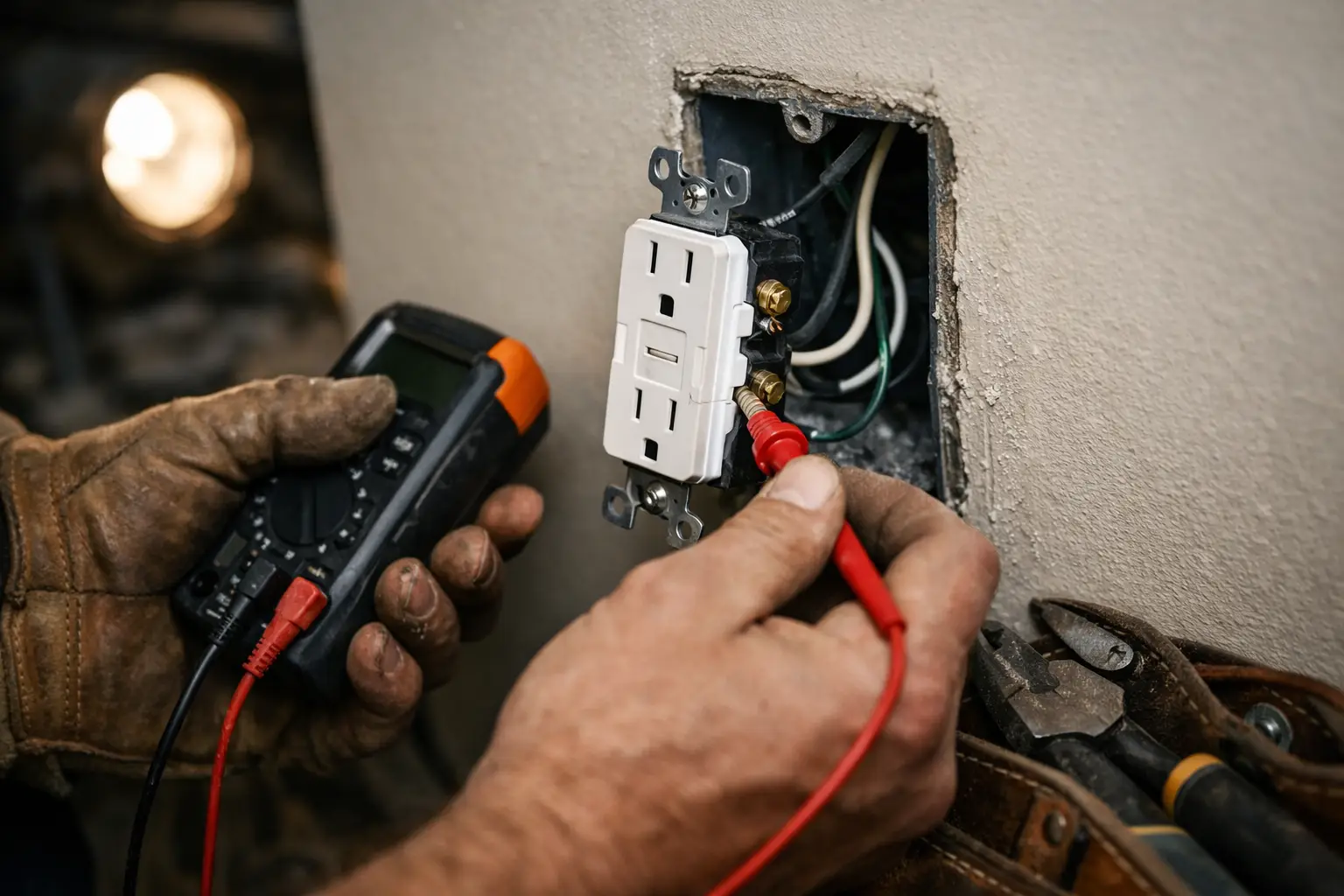
You plug in a bathroom hair dryer or reset the garage receptacle, and a few minutes later the same thing happens again. If your GFCI outlet keeps tripping, that is not random behavior. The device is reacting to something it sees as unsafe, and the real question is whether it is doing its job, failing internally, or catching a wiring problem somewhere else on the circuit.
That distinction matters. A nuisance trip can be annoying. A trip caused by leakage current, moisture, or a damaged downstream receptacle is the kind of issue that can keep coming back until somebody diagnoses the circuit properly.
What a GFCI outlet is actually watching
A GFCI does not trip because the breaker thinks you are using too much power. It trips when it detects an imbalance between the current leaving on the hot and returning on the neutral. In plain language, some of that electricity is going somewhere it should not. That could mean through water, through a failing appliance, through damaged insulation, or through a person.
That is why these devices are required in bathrooms, kitchens, garages, laundry areas, exterior locations, crawl spaces, unfinished basements, and other places where moisture or grounded surfaces raise the risk. When a GFCI trips, it is not being picky. It is reacting to a small fault by design.
Why a GFCI outlet keeps tripping
The most common cause is a problem with something plugged into it. Hair dryers, pressure washers, freezers in the garage, old refrigerators, sump pumps, and countertop appliances can all develop leakage to ground as they age. Sometimes the appliance still runs, which fools homeowners into thinking it must be fine. It may not be.
Moisture is another big one. We see this around exterior receptacles, garage outlets, covered patios, and bathrooms where steam gets into a worn device box. A GFCI does not need standing water to react. A damp connection, dirty device, or weathered cover can be enough.
Then there is the wiring itself. A loose neutral, nicked conductor, bootleg grounding issue, or a downstream receptacle with corrosion can trigger repeated trips. One thing that confuses homeowners is that the GFCI you are resetting might be protecting several regular receptacles farther down the line. So the problem may not be at the device you are touching. It may be in the guest bathroom, behind the garage freezer, or at an outside receptacle nobody has used in months.
Sometimes the GFCI is simply worn out. These devices do fail. They contain internal electronics, and they live in heat, humidity, and dusty environments. An older GFCI that resets inconsistently, feels loose, or trips with nothing plugged in is a strong candidate for replacement, but that should still be verified instead of guessed.
Start with the simple question: what changed?
If the outlet has worked for years and just started tripping, think about what is different. Did you plug in a new appliance? Did recent rain hit an exterior wall? Did a bathroom remodel add a mirror light, bidet seat, or fan? Did somebody reset a breaker after a storm and now the garage receptacles act strange?
That timeline helps narrow the search. Electrical problems often look mysterious until you line them up with one change in the home. A new load on an old circuit can expose weak connections. Water intrusion after a storm can show up first as a GFCI trip. A receptacle hidden behind storage in the garage may have taken a hit from humidity for years before it finally started causing trouble.
What you can check without getting into dangerous DIY work
You do not need to open devices or start pulling receptacles out of boxes to gather useful information. Start by unplugging everything on the affected outlet and any nearby receptacles that may be protected by the same GFCI. Then reset it. If it holds with everything unplugged, one of those plugged-in items is the likely problem.
If it still trips with nothing connected, that points more toward the device itself, moisture, or a wiring issue downstream. Walk the areas that may be tied to that GFCI and look for obvious clues like an exterior cover left open, a bathroom receptacle that feels warm, a garage outlet with corrosion, or a tripped receptacle in another room.
Use the built-in test and reset buttons only as intended. If the reset will not hold, or if the test button behaves inconsistently, that is useful information for the electrician. So is whether the issue happens only during rain, only when a certain appliance runs, or only at certain times of day.
When the problem is the appliance, not the outlet
A lot of people assume the receptacle is bad because that is the part they can see. In the field, we often find the opposite. The GFCI is doing exactly what it is supposed to do, and the real issue is a motor, heating element, or cord cap beginning to fail.
This happens a lot with garage refrigerators and freezers. They may run for a while, then trip once the compressor cycle starts. Bathroom appliances are another frequent offender because heat and moisture are hard on them. Outdoor equipment is rough on cords and internal insulation, especially after a season stored in a shed or garage.
The trade-off here is simple. Replacing a GFCI because it is easy might seem cheaper in the moment, but if the actual fault is in the appliance or wiring, the new device will start tripping too. That is why real diagnosis beats parts-swapping.
When repeated tripping points to a bigger house wiring issue
If multiple GFCIs are acting up, lights on the same circuit flicker, or the tripping started after other electrical work, step back and look at the bigger picture. We have seen repeated GFCI trips tied to shared neutral problems, loose terminations, overloaded bathroom circuits, failed exterior receptacles, and older homes with patchwork additions over the years.
This is especially common in houses that have been renovated in stages. Somebody adds a receptacle here, taps a circuit there, and ten years later the symptoms start showing up in weird ways. The GFCI becomes the messenger. It is not always the root cause.
For homeowners in Huntsville, Madison, and Harvest, this comes up in older neighborhoods and in homes that have added modern loads without a full look at the existing electrical system. An EV charger, new garage freezer, bathroom heater, or outdoor kitchen will not directly cause a GFCI to trip, but added demand can expose weak workmanship and tired connections that were already there.
Signs you should stop resetting and call a licensed electrician
If the GFCI trips immediately with nothing plugged in, if it feels warm, if you smell anything hot, or if it protects critical equipment like a sump pump or refrigerator, it is time to stop guessing. The same goes for outdoor and garage circuits after heavy rain, or any situation where the reset only holds temporarily.
This is not about scaring anybody. It is just a matter of knowing where homeowner troubleshooting ends. A proper diagnosis may involve tracing what is on the load side of the GFCI, testing for leakage, checking terminations, and verifying that the device is installed and protecting the right locations correctly. That is licensed electrician work, not trial-and-error in a live box.
A good service call should leave you with a straight answer. Was it a failed device, a bad appliance, water intrusion, or a wiring defect? Is the circuit safe after repair, and does anything else in the house need attention? That is the difference between fixing a symptom and actually solving the problem.
The practical bottom line on a GFCI outlet that keeps tripping
If a GFCI outlet keeps tripping once and then behaves after you unplug a faulty appliance, the fix may be simple. If it trips with nothing plugged in, after rain, or across multiple protected outlets, there is usually more to the story. The device may be doing its job. It may also be warning you about a problem that sits out of sight until somebody tests the circuit properly.
The right move is not to keep mashing the reset button and hope it settles down. Pay attention to the pattern, note what changed, and get it diagnosed before a small nuisance turns into a bigger repair. That is usually cheaper, faster, and a whole lot less frustrating.