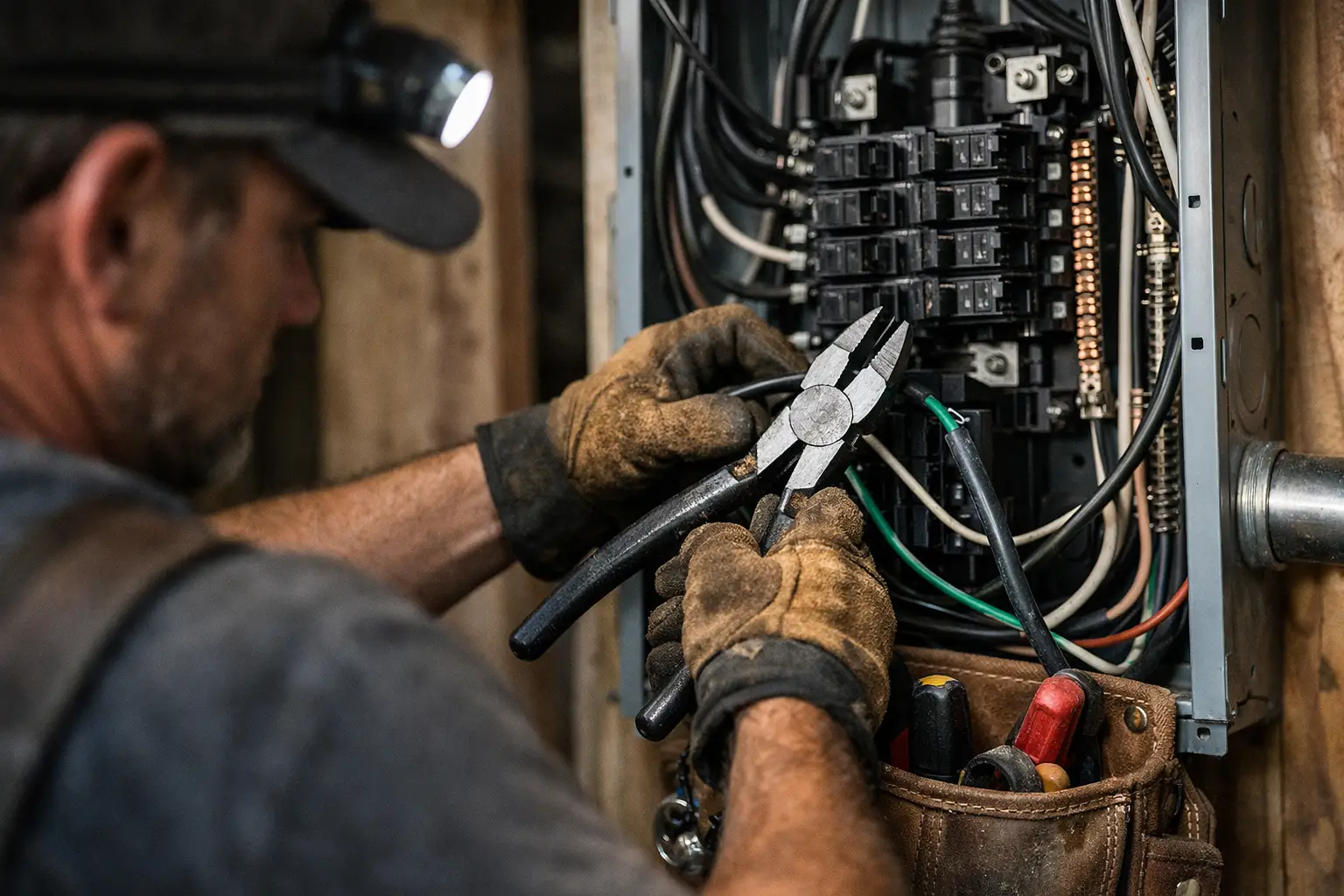
A breaker that keeps tripping is not usually a “bad breaker.” A dead outlet in one room is not always just a worn receptacle. And a flickering light can be a nuisance, or the first sign that something deeper is wrong. That is where a good residential electrical repair guide helps. It gives you enough information to understand the problem, ask better questions, and know when the repair belongs in a licensed electrician’s hands.
Most homeowners do not need a crash course in wiring theory. They need practical answers. Why did half the house lose power? Why does the microwave trip the kitchen circuit? Why did the home inspector flag the panel? Those are real-world repair questions, and the right answer depends on what is happening upstream, not just what stopped working.
What a residential electrical repair guide should actually do
A useful residential electrical repair guide should not turn into a DIY dare. Electrical repair at the residential level can involve overheated terminations, undersized circuits, damaged conductors in the attic or crawlspace, failed breakers, neutral problems, and panel issues that affect the whole house. Some of those problems start small and stay small. Others get expensive because somebody guessed instead of diagnosing.
That is the difference between handyman logic and electrician logic. Handyman logic says, “the outlet quit, replace the outlet.” Electrician logic asks what fed that outlet, what else is on the circuit, whether the connection failed under load, whether the device is backstabbed, whether a GFCI upstream is open, and whether the symptom points to a loose neutral or a shared branch circuit issue. Same outlet, very different level of thinking.
The most common home electrical repair problems
Breakers that trip repeatedly
If a breaker trips once after you run too many loads, that may be exactly what it was supposed to do. If it trips over and over under normal use, the cause matters. It could be circuit overload, a failing appliance, a short, an arc fault issue, or a breaker that is no longer holding properly.
The trade-off here is simple. Sometimes the fix is straightforward, like separating a few heavy loads onto different circuits. Other times the tripping is telling you the house no longer matches how people live in it. Older homes in Huntsville, Madison, and Harvest were not built with today’s demand in mind. Add a garage freezer, air fryer, space heater, treadmill, EV charger, or hot tub, and the original circuit layout starts showing its age.
Flickering or dimming lights
A single light that flickers can be a bulb, a fixture issue, or a bad switch. But if lights dim when the HVAC kicks on, or several rooms flicker at once, that points to a broader problem. Voltage drop, loose connections, overloaded circuits, and service-side issues all belong on the table.
This is one of those areas where context matters. A brief dimming event when a large motor starts can happen even in a healthy system. But regular flicker, especially if it affects multiple areas, deserves a real diagnosis. That is not a “wait and see” symptom forever.
Dead outlets or partial power loss
When homeowners say, “one wall quit,” there are a few usual suspects. A tripped GFCI may be feeding standard outlets downstream. A loose connection may have opened part of the circuit. A failed receptacle can interrupt power to other devices on the same run. In older homes, worn terminations and aging devices are common.
Partial power loss gets more serious when rooms act strange instead of simply going dead. Bright lights in one area and weak power in another can indicate a neutral issue, which is not a casual repair. That kind of symptom needs fast, qualified attention.
Hot, buzzing, or discolored devices
An outlet or switch should not feel hot in normal use, and it should not buzz. Discoloration around the device, a burnt smell, or visible heat damage means there has likely been arcing or overheating. Sometimes the damage is limited to the device. Sometimes the conductor, insulation, and box area have all taken a hit.
This is where homeowners get in trouble by replacing the visible part and assuming the problem is solved. If the wire behind the device is compromised, the new switch or receptacle is just covering the same failure point.
When the repair is really a system problem
A lot of residential electrical calls are not isolated repair calls at all. They are capacity problems, aging infrastructure, or code issues finally surfacing as symptoms.
An older panel may still energize the house, but that does not mean it is in good shape. Some panels have poor track records. Others are simply maxed out, double-tapped, or full of improvised add-ons from years of remodels and quick fixes. If you are adding a car charger, finishing a bonus room, installing a new oven, or dealing with a home inspection punch list, the smart move is to look at the whole system instead of patching one complaint at a time.
That is also why repair and upgrade work often overlap. A homeowner may call because the kitchen breaker trips, but the actual long-term fix may involve a dedicated circuit, panel rework, or correcting old splices in the attic. Nobody likes hearing that a simple symptom has a bigger cause. But straight answers beat cheap guesses every time.
What homeowners can check before calling
There is a safe middle ground between doing nothing and trying to play electrician. You can note which breakers tripped, what was running when the problem happened, whether the issue affects one room or several, and whether any GFCI devices have tripped. You can also pay attention to patterns. Does the problem only happen during storms, during peak AC use, or when a specific appliance turns on?
That information helps. It shortens diagnosis time and often reveals whether the issue is branch-circuit related, appliance related, or tied to the service and panel. What you should not do is open energized equipment, replace breakers blindly, or start moving conductors around in a live panel. That is where a repair call becomes a hazard.
How a licensed electrician approaches residential electrical repair
Good repair work starts with diagnosis, not part swapping. The first job is figuring out whether the symptom is the failure or just the evidence. That means checking load behavior, verifying voltage, tracing the affected portion of the circuit, inspecting terminations, and evaluating whether the problem is isolated or systemic.
It also means being honest about what the house is telling you. Sometimes a breaker replacement makes sense. Sometimes it does not. Sometimes a failed outlet is exactly that. Other times it is the downstream result of heat, poor workmanship, backstabbed devices, or an overloaded multi-use circuit that should have been split years ago.
A technician-first company will explain that distinction plainly. No theater, no commissioned sales script, no inflated mystery around basic electrical principles. Just the problem, the likely cause, and the repair path that makes sense for the home.
Residential electrical repair guide for older homes
Older homes deserve a separate mention because the rules change. Repair work in a newer subdivision often means fixing one failed component. Repair work in an older house often means uncovering layers of history. You may find mixed wiring methods, abandoned feeds, crowded boxes, aging devices, bootleg fixes, or circuits that no longer fit modern use.
That does not mean every older home needs a full rewire. Sometimes targeted repairs are the right answer. Sometimes panel upgrades, surge protection, dedicated appliance circuits, or cleanup of high-risk problem areas can buy a lot of reliability without tearing the house apart. It depends on condition, load demand, and future plans.
If you are selling, remodeling, or trying to get ahead of recurring electrical issues, that broader view matters. The cheapest repair is not always the least expensive decision a year from now.
Choosing the right repair mindset
Homeowners usually call after something stops working. Fair enough. But the better mindset is to treat electrical repairs as information, not just inconvenience. A tripped breaker, warm outlet, dead room, or inspector note is the house telling you something about capacity, wear, or workmanship.
If you are in Huntsville, Madison, or Harvest, and you want direct answers from the person who actually understands residential systems in the field, that matters more than a polished sales pitch. Huntsville Wire and Home is built around that idea.
The best time to take electrical symptoms seriously is before they stack up into a bigger outage, a failed inspection, or a repair that should have been a planned upgrade. A little clarity early saves a lot of frustration later.