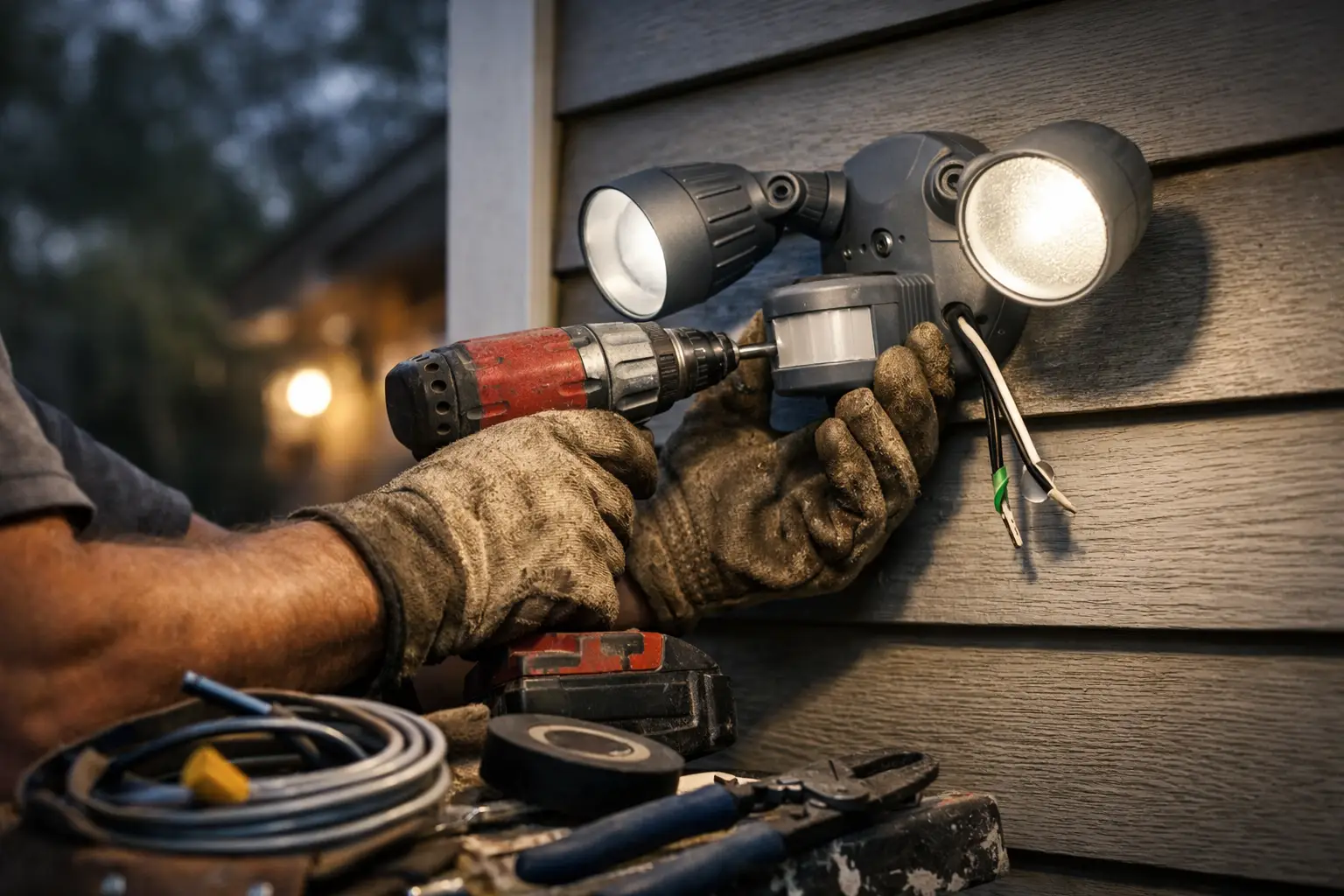
A dark side yard, a back door with no light, or a driveway camera that sees more glare than detail – those are the jobs that usually start the conversation. Homeowners want to install outdoor security lights for a simple reason: they want to see what is happening around the house without guessing, without dead spots, and without a sloppy add-on that creates new electrical problems.
Good security lighting is not just about hanging a bright fixture over the garage. It is about coverage, wiring method, switching, weather exposure, and whether the existing circuit can handle what you are adding. If the light placement is wrong, you get shadows. If the fixture is too harsh, you blind yourself and wash out the camera view. If the wiring is done carelessly, you end up with nuisance trips, water intrusion, or a setup that looks like an afterthought.
Before you install outdoor security lights, start with the problem
The best outdoor lighting plans start with one question: what are you trying to fix? A lot of homeowners say they need “more light,” but the real issue is usually more specific. Maybe the back steps disappear at night. Maybe the side yard is where the gate is, but there is no visibility from the kitchen window. Maybe packages are being dropped at a porch that is too dim for the camera to catch faces clearly.
That matters because security lighting should match the actual use of the space. A front walk needs controlled, even light. A rear patio may need broad coverage without blasting the house next door. A narrow side yard might need a tight beam and a well-placed motion sensor rather than one giant floodlight mounted too high.
This is where people waste money. They buy the brightest fixture on the shelf, put it in the easiest spot, and hope brightness will cover up bad planning. It usually does not.
Where outdoor security lights work best
Most homes do not need lights everywhere. They need lights in the right places.
The most useful locations are usually the front entry, garage approach, back door, driveway edge, side gates, and any path between the house and yard features like a detached shed or pool equipment area. Corners can be useful too, but only if the fixture is positioned to fill a blind spot rather than throw light into open air.
Height matters more than most people think. Mounting too low can create hot spots and easy tampering. Mounting too high can reduce usable light on the ground and make motion sensing less reliable. You also have to think about rooflines, soffits, gutters, brick, siding, and whether there is a practical path to run wiring without turning the exterior of the house into a patchwork project.
A good installer also thinks about what the light does to your own eyes. If you step out the back door and the fixture hits you full force, your night vision is shot. If a camera is aimed into that same glare, image quality drops. More lumens is not always better.
Fixture type changes the result
When homeowners want to install outdoor security lights, they usually picture a motion flood. That can be the right answer, but not every time.
Motion-activated floodlights are great for driveways, side yards, and rear access points where occasional activity matters more than constant illumination. Dusk-to-dawn fixtures make more sense in areas where you want predictable light every evening, such as a front entry or a dark corner that stays active after sunset. Integrated LED wall packs and architectural security fixtures can work well when you want coverage without the bulky look of old-school twin-head floods.
Then there is color temperature. Cooler light can feel brighter and sharper, but too blue-white can look harsh on a home and make some spaces feel commercial. Warmer light is easier on the eyes, but if it is too warm, camera footage can lose some clarity. There is a middle ground, and the right choice depends on the fixture location and what you need to see.
Wiring is the part that separates a clean job from a mess
This is where a lot of outdoor lighting jobs go sideways. The fixture itself is easy to shop for. The hard part is getting power to the right place, protecting the wiring properly, and tying it into the home electrical system in a way that is safe and code compliant.
Exterior lighting may involve attic access, fishing cable through finished walls, weatherproof boxes, properly sealed penetrations, GFCI protection where required, and switch leg planning that makes sense for how you actually live in the house. On some homes, there is a straightforward path from an existing lighting circuit. On others, the house layout, brick veneer, or limited attic access makes the run more involved.
Older homes add another layer. You may find crowded boxes, undersized circuits, brittle insulation on older conductors, or previous handyman wiring that should have been corrected years ago. That is one reason outdoor lighting upgrades often reveal larger electrical issues. The new fixture is not the problem. It is just the first thing that made someone look closely.
Install outdoor security lights without creating glare and shadows
A security light should help you see movement, faces, steps, and access points. It should not make your property look like a prison yard.
The cleanest setups use overlapping coverage instead of one ultra-bright fixture trying to do everything. For example, a pair of lower-output fixtures aimed correctly often works better than one large flood mounted over the garage. You get fewer shadows, less glare, and a more usable result for both people and cameras.
Beam spread matters too. Wide flood patterns are useful for open areas like driveways. Narrower distributions are better for side yards and specific paths of travel. Motion sensors should be aimed to catch cross-traffic rather than direct approach when possible, because sensors often detect lateral movement more reliably.
This is also where neighbor impact comes in. A badly aimed security light that pours into the next yard or bedroom window is not a security upgrade. It is just annoying. A good installation respects property lines and still gives you the coverage you need.
Controls are just as important as the fixture
A lot of homeowners focus on the light and forget about how they want it to behave. That is a mistake.
Some people want motion only. Others want the light on at dusk and brighter on motion. Some want a manual override at the switch. Others want smart control integrated with cameras or routines. None of those choices are wrong, but they affect fixture selection and wiring design.
A basic motion flood over a back door may be enough for one house. Another home may need switched eave lights at key corners, plus a motion light over the gate, plus a front entry fixture that stays on for evening visibility. The right setup depends on your routines, not just the product packaging.
The practical question is this: when you walk out at night, do you want the light already on, or do you want it to react? The answer changes the plan.
When a simple lighting job is not actually simple
Outdoor security lighting sounds like a small project until the house starts telling the truth.
If there is no nearby power source, you may be looking at significant wire routing. If the existing exterior box is loose, corroded, or mounted poorly, it may need replacement. If the circuit is already overloaded with garage receptacles, freezers, or exterior devices, adding more is not something to guess at. If you want multiple fixtures covering different sides of the house, the cleanest solution may involve new switching or a revised lighting layout altogether.
That is why these jobs benefit from a licensed residential electrician instead of a general handyman. The issue is not whether someone can physically fasten a light to the house. The issue is whether the wiring method, box fill, circuit loading, protection, and weatherproofing are done right the first time.
For homeowners in Huntsville, Madison, and Harvest, that matters even more because a lot of houses here range from newer subdivisions to older homes with additions, remodel history, and mixed-quality electrical work. What looked simple from the driveway can be very different once you get into the attic or open the box.
What to expect from a professional installation
A solid security lighting job should start with a walkthrough, not a sales pitch. The electrician should ask what areas feel unsafe or underlit, whether cameras are part of the plan, how you want the lights controlled, and what parts of the house are practical for wiring access.
From there, the conversation should get specific. Fixture locations. Mounting heights. Wiring routes. Whether existing circuits are usable. Whether the current setup has code issues that need to be corrected before anything new is added. That is the difference between a real solution and a quick install that leaves you with callbacks later.
You should also expect honest trade-offs. Sometimes the perfect light location is expensive because access is difficult. Sometimes a slightly different placement gets 90 percent of the result with far less disruption. Sometimes the better answer is two modest fixtures instead of one large one. Straight answers matter more than hearing what sounds easiest in the moment.
If you are planning to install outdoor security lights, think beyond the fixture itself. Think about what you need to see, how the house is wired, and whether the end result will still make sense a year from now. Good exterior lighting should feel intentional every night you pull into the driveway, take out the trash, check the gate, or hear something outside after dark.