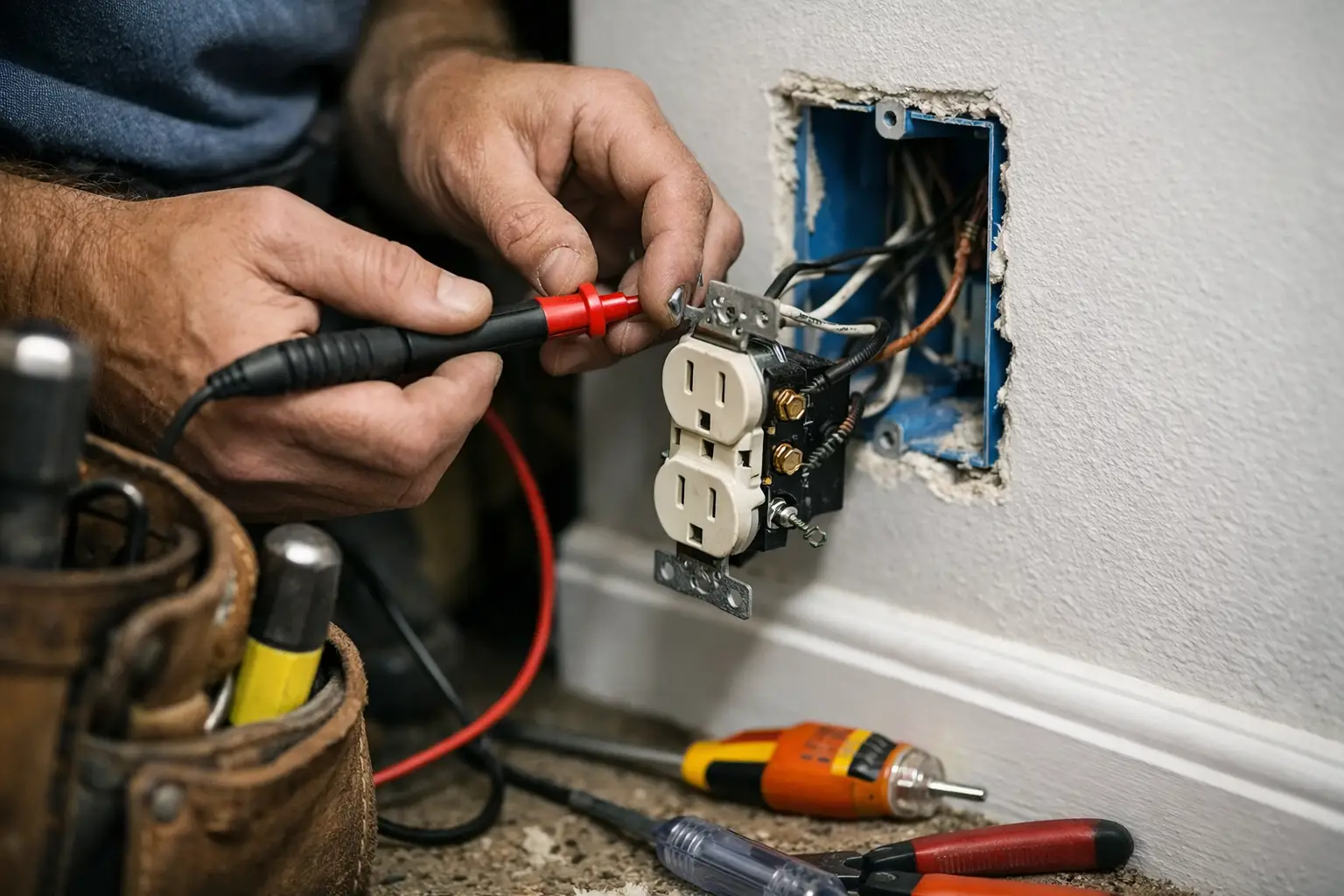
A dead outlet usually shows up at the worst time – your freezer in the garage stops running, the coffee maker won’t power on, or half a bathroom goes dark and nothing obvious looks wrong. If you’re trying to figure out how to troubleshoot dead outlets, the goal is not to play electrician. The goal is to narrow down the cause safely, avoid making it worse, and know when the problem has moved past a simple reset.
Most dead outlets come from a handful of common issues. A tripped breaker, a tripped GFCI, a failed backstab connection, a loose splice in another box upstream, or a worn-out receptacle can all kill power. The tricky part is that the dead outlet is not always where the actual problem lives.
How to troubleshoot dead outlets without guessing
Start with the simplest question first. Is the outlet actually dead, or is the device plugged into it the problem? Plug in something you know works, like a lamp or phone charger. If that second device also gets nothing, you’re dealing with a power issue, not a bad appliance.
Next, look at what else is out. One dead outlet by itself points you one direction. A group of outlets, a bathroom receptacle, a garage outlet, or an outside outlet all failing together points you another. Patterns matter in electrical troubleshooting. A single dead receptacle may be a worn device or loose termination. Several dead receptacles often mean there’s one upstream failure feeding the rest of the circuit.
Go to the electrical panel and look for a tripped breaker. A breaker does not always look fully off. Many sit in the middle position when they trip. Reset it by switching it firmly off, then back on. If it trips again right away, stop there. That usually means an overload, short, ground fault, or equipment problem that needs proper diagnosis.
If the breaker seems fine, check for a tripped GFCI receptacle. Homeowners are often surprised by how many “mystery dead outlets” are really GFCI-related. One bathroom GFCI can protect other bathrooms, garage outlets, exterior outlets, and sometimes even a nearby bedroom or basement outlet depending on how the house was wired. Press the reset button on any GFCI you find in bathrooms, kitchen areas, garage, laundry, exterior locations, and utility spaces.
The dead outlet may not be the bad outlet
This is where a lot of frustration starts. You may be standing in front of the dead receptacle, but the actual failure could be one room over. We see this often in older homes around Huntsville, Madison, and Harvest where a circuit has been extended over time and the feed path is not obvious.
If one receptacle lost power after years of normal use, there’s a decent chance the failure is at another outlet, switch box, or GFCI ahead of it on the same branch circuit. That upstream point may have a loose wire connection, heat damage, or a failed device passing power downstream. Backstabbed receptacles are a common culprit. They were widely used because they’re fast to install, but they’re more prone to failure than properly terminated screw connections.
You might also notice clues beyond “it doesn’t work.” Maybe the outlet felt warm last week. Maybe a plug started slipping out easily. Maybe the lights in that room flickered when a vacuum or space heater kicked on. Those details matter because they point toward a connection problem, not just a random dead device.
What causes dead outlets most often
The most common cause is still a simple trip event. Hair dryers, bathroom heaters, garage refrigerators, treadmills, and portable AC units can all push a circuit hard enough to trip protection. That is the best-case scenario because the system did its job.
After that, failed receptacles are common, especially in older homes or in places where cords get plugged and unplugged constantly. Kitchen, bath, garage, and exterior outlets wear out faster than living room outlets. A failed GFCI is also common. These devices do not last forever, and when they fail, everything downstream can go dead too.
Loose connections are where things get more serious. A loose splice or receptacle termination can create heat over time, especially on high-use circuits. Sometimes the outlet just dies quietly. Sometimes you get intermittent power first. Sometimes you get discoloration on the device or cover plate. If you smell something hot or see browning around an outlet, stop using that circuit and get it checked.
There’s also the less common but real possibility of a broken conductor in the wall, a damaged cable in an attic or crawlspace, or a panel-related issue. Those are not homeowner reset problems. Those are tracing and repair problems.
When a dead outlet is more than a minor nuisance
A dead outlet can be a small isolated failure. It can also be a symptom of a circuit that’s undersized, poorly extended, or carrying more load than the house was originally built for. That matters in older neighborhoods where homes were not designed around today’s electrical demand.
If your dead outlets keep happening in the same part of the house, pay attention. Repeated trips in a bathroom, kitchen, garage, or outside circuit may mean the circuit is overloaded for the way you actually use the home. The fix might not be replacing one receptacle. It might be separating loads, adding a dedicated circuit, correcting a shared feed issue, or updating protection to current code where needed.
That is one reason homeowners get frustrated with surface-level service calls. Swapping a device without understanding why it failed is not diagnosis. It’s just changing parts and hoping.
Safe checks you can make before calling
There are a few homeowner-safe checks that make sense. Confirm the breaker is fully reset. Press reset on every GFCI you can locate. Test the outlet with a known working device. Notice what else is dead on the same circuit. Pay attention to any signs of heat, smell, crackling, or intermittent power.
After that, the return on DIY effort drops fast. Once the next step involves pulling receptacles out of boxes, opening splices, or working around energized conductors, that’s licensed electrician territory. Residential troubleshooting sounds simple until the dead outlet is tied into a multi-location run, a remodel splice, or an older wiring method with surprises hidden in the wall.
If you do call, the best information you can give is plain and specific. Say what is dead, what still works, whether the breaker tripped, whether any GFCI reset fixed anything, and whether you noticed warmth, buzzing, flickering, or a burning smell. That kind of information shortens diagnosis time because it points the electrician toward protection devices, loose terminations, failed receptacles, or hidden upstream faults.
When to stop and call a licensed electrician
Some dead outlet situations are not worth experimenting with. If the breaker will not hold, if the outlet shows burn marks, if plugs feel loose, if the issue affects multiple rooms unexpectedly, or if the outage started after water exposure, stop there. The same goes for homes with older wiring where the failure may involve brittle insulation, mixed wiring methods, or prior handyman work hidden in a junction box.
This is especially true if the dead outlet serves a refrigerator, sump system, medical device, freezer, or anything else you rely on. Losing power is annoying. Losing power to a critical load can turn into spoiled food, water problems, or a bigger repair bill.
At Huntsville Wire and Home, this is the kind of call we take seriously because outlet failures are often less about the outlet and more about what the circuit is trying to tell you. Good troubleshooting is not flashy. It’s methodical. You rule out the simple causes, verify the circuit path, inspect terminations, and fix the actual failure instead of guessing.
How to troubleshoot dead outlets and avoid repeat problems
If you want fewer dead outlets in the future, think in terms of load and condition. High-draw appliances should be on the right circuits. Worn-out receptacles should be replaced before they start heating up. Outdoor and garage outlets need proper weather protection and working GFCI protection. Older homes may need circuit updates if modern use has outgrown the original design.
And if one dead outlet turns into a pattern, don’t ignore it just because resetting something got the power back. Electrical problems often give a warning before they become urgent. Catching them early is cheaper, cleaner, and a lot less aggravating than waiting until part of the house goes dark for good.
A dead outlet is rarely random. There’s always a reason, and the sooner you track down the real one, the better your next repair decision will be.