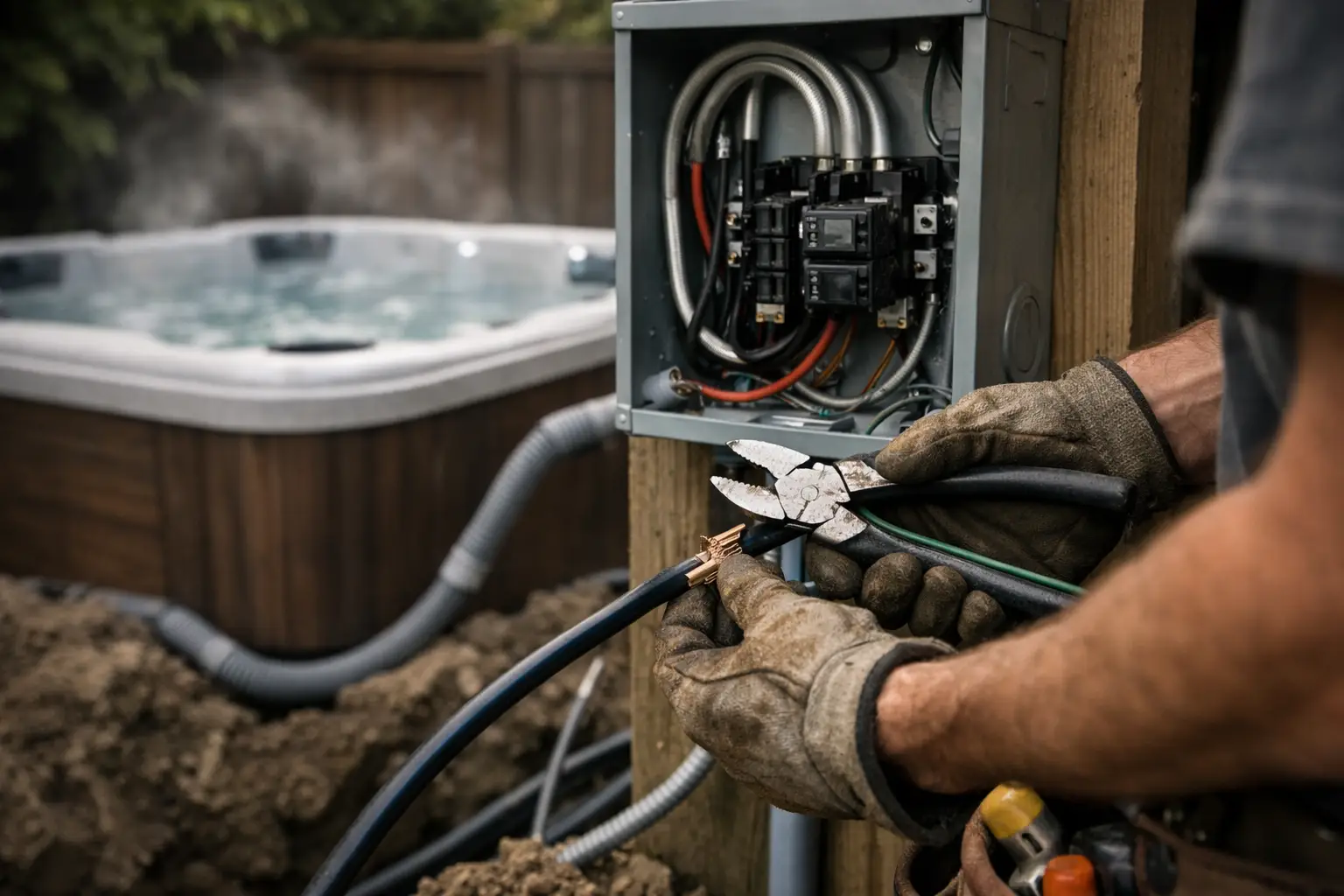
A hot tub is one of those upgrades that sounds simple until the electrical part shows up. Most homeowners start with the tub itself, the pad, and the backyard layout. Then the real question hits – what are the hot tub electrical requirements, and is your house actually ready for them?
That question matters because a hot tub is not just another backyard appliance. It is a high-load piece of equipment sitting outside, around water, often running heaters, pumps, blowers, and control systems at the same time. If the circuit, disconnect, grounding, bonding, or panel capacity is wrong, the install can stall fast. Worse, it can become a safety problem that should have been caught before the tub ever arrived.
What hot tub electrical requirements usually include
Most residential hot tubs need a dedicated 240-volt circuit, usually either 50 or 60 amps, but that is not universal. Some smaller plug-and-play models run on 120 volts. That sounds easier, and sometimes it is, but even those units come with limits. A 120-volt spa may heat slowly and may not run all functions at full output the same way a hardwired unit can.
For the more common hardwired setup, hot tub electrical requirements typically include a dedicated breaker sized to the manufacturer specs, GFCI protection, an outdoor disconnect in the proper location, and correct bonding and grounding. The exact wire size depends on the amp draw, wire run length, and equipment listing. This is where homeowners get tripped up. They hear “50-amp hot tub” and assume the answer is always the same. It is not.
The manufacturer instructions matter just as much as the electrical code. If the spa calls for a certain breaker size or conductor setup, that is not a suggestion. The unit has to be installed to its listing.
Why the panel matters more than most people expect
A lot of hot tub projects in Huntsville, Madison, and Harvest hit the same wall – the backyard is ready, but the panel is already crowded or near capacity.
A hot tub can be a major new load on a house, especially if you already have two HVAC systems, an electric water heater, an oven, a dryer, and maybe an EV charger too. In newer homes, there may still be room. In older homes, especially homes with smaller services or packed panels, adding a spa may trigger a bigger conversation.
You may need more than just a breaker space
Homeowners often ask whether the electrician can “just add a breaker.” Sometimes yes. Sometimes no. A panel might have one physical space left but still not have the load capacity to support another large 240-volt circuit. In other cases, the panel is full, the service is undersized, or the brand of panel creates compatibility issues with new breakers.
That is why a real evaluation matters. This is not about selling a panel upgrade you do not need. It is about knowing whether the house can carry the added load without creating nuisance tripping, overheating issues, or a code problem during inspection.
Location changes the job
The distance from the panel to the hot tub has a direct impact on labor, wire size, and installation cost. A spa ten feet from the panel is one kind of job. A spa across the yard, behind a detached structure, with a finished basement ceiling in the path is a different animal.
The route matters. Sometimes the cleanest path is through an attic. Sometimes it is through a crawlspace. Sometimes it requires exterior conduit. Sometimes the backyard layout, fencing, concrete, or existing landscaping changes everything. The electrical requirements stay the same in principle, but the method of getting power there can vary quite a bit.
Outdoor disconnects are not optional details
The disconnect location is one of those things homeowners usually do not think about until late in the project. For a hot tub, the disconnect has to be installed where it is accessible and code-compliant relative to the water and equipment. That means it cannot just go anywhere that looks convenient.
This detail often affects where conduit runs, how visible the equipment will be, and how the finished installation looks from the patio or deck. A good install is not just safe on paper. It also looks intentional when the job is done.
Bonding and GFCI protection are where safety lives
When people talk about hot tub electrical requirements, they usually focus on voltage and amperage. Those matter, but bonding and GFCI protection are the parts that really separate a proper installation from a risky one.
GFCI protection is there because the equipment is outdoors and around water. If there is a fault, that protection is designed to trip fast. Bonding is different. Bonding connects metal parts and nearby conductive components so they stay at the same electrical potential. That reduces shock risk around the tub area.
This is also why spa installations are not handyman work. The details matter, and they matter in ways that are not obvious if you are just looking at whether the pumps turn on. A tub that powers up is not automatically a tub that was wired correctly.
Permits and inspections are part of the real job
A legitimate hot tub installation usually involves permits and inspection requirements. Some homeowners try to avoid that because they want the project done faster or cheaper. That shortcut can come back to bite you later, especially when you sell the house, file an insurance claim, or troubleshoot a recurring electrical issue.
Permitted work creates a paper trail and forces the installation to be checked against actual requirements. That is not bureaucracy for the sake of it. It is one of the few ways homeowners can separate code-compliant work from guesswork.
In this kind of project, the cheapest install is not always the least expensive outcome. If an undersized feeder, wrong breaker, or bad disconnect placement has to be corrected later, you pay twice.
Common homeowner questions before a hot tub install
Can any electrician wire a hot tub?
Not every electrician handles residential service work the same way, and not every company is set up for detail-heavy backyard infrastructure. A hot tub job can involve load calculations, panel evaluation, exterior wiring methods, disconnect placement, and coordination with a pad, deck, or patio schedule. You want someone who does this type of work regularly, not someone figuring it out in real time.
Do all hot tubs need 240 volts?
No. Some smaller units use 120 volts, but many full-size tubs need 240 volts on a dedicated circuit. The right answer comes from the manufacturer specifications, not a guess based on size alone.
Will a hot tub require a panel upgrade?
Maybe. If your existing service has enough capacity and your panel can accept the circuit, maybe not. But if the home already has several large electric loads, a hot tub may push the system past what makes sense. That is especially common in older homes that were never designed for modern add-ons.
How early should you bring in the electrician?
Earlier than most people do. Ideally, the electrical side gets checked before the hot tub is delivered and before the final site location is locked in. That gives you time to address panel issues, permits, conduit planning, and disconnect placement without scrambling at the end.
What affects the final cost
Homeowners usually want a clean number up front, and that is reasonable. But with hot tub wiring, cost depends on a handful of real field conditions.
The first is the electrical service itself. If the panel has room and capacity, the price stays in one lane. If the job needs a subpanel, service upgrade, or major rework, it moves into another lane fast. The second factor is distance and access. Long wire runs, tight attic paths, finished spaces, concrete obstacles, and yard crossings all add labor.
The third factor is the spa equipment requirements. A straightforward 50-amp setup is one thing. A more specialized configuration, unusual disconnect requirement, or site-specific bonding issue is another. None of that is fluff. It is the difference between quoting from a brochure and quoting from the actual house.
The practical way to approach a hot tub project
If you are planning a hot tub, do not start by asking only what the wiring costs. Start by asking whether the house is ready for it. That means checking the panel, confirming the spa specs, looking at the route, and understanding what the permit and inspection process will require.
That approach saves time because it surfaces the real constraints early. It also keeps you from getting halfway through a backyard project and finding out the electrical side was the one piece nobody really verified.
For homeowners around Huntsville, this is one of those projects where direct answers matter. A straightforward electrician should be able to tell you whether your panel can support the load, whether the route is clean or complicated, and whether the spa location creates code issues before anyone starts pulling wire.
A hot tub should feel like a backyard upgrade, not the beginning of an electrical mess. If the planning is honest and the installation is done right, you get the part you actually wanted – hot water, working jets, and one less thing to worry about when the sun goes down.