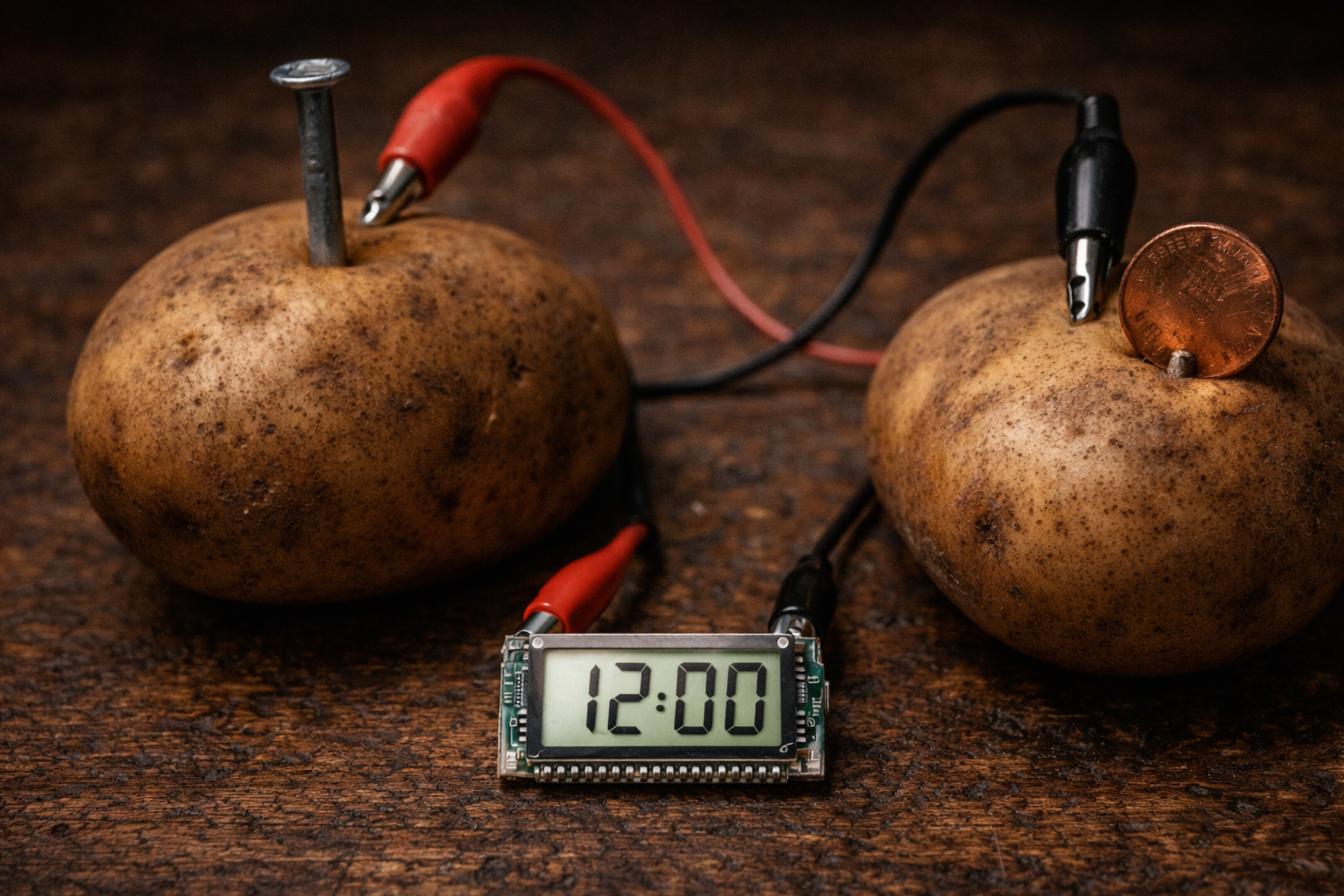
The Potato Clock
This potato has more energy than your phone charger.
It’s the classic science fair clichè: Sticking nails into a potato to turn on a digital clock. But 90% of people get the lesson wrong.
They think the electricity is coming inside the potato. It isn’t. The potato is just the road; the metals are the cars.
The Setup Get two potatoes. Place them side-by-side. Stab one Galvanized Nail (Zinc) and one Penny (Copper) into each potato. Keep the metals far apart.
The Wiring (The Bridge): Electricity needs a path. We have to connect the two potatoes together first.
-
Take a wire and connect the Nail in the First Potato to the Penny in the Second Potato.
-
This is the “Bridge.” It stacks the voltage.
The Power Up (The Clock): Now you have two empty spots left: A Penny on the left, and a Nail on the right. 3. Take the RED wire from the clock and touch it to the Penny. 4. Take the BLACK wire from the clock and touch it to the Nail.
The Result: The screen blinks on. One potato gives 0.8 volts (too weak). Two potatoes connected in a line (Series) gives 1.6 volts. That is exactly enough to wake up the microchip.
The Real Science: When you shove a zinc nail (galvanized) and a copper penny into that spud, the phosphoric acid inside acts as an electrolyte. It creates a chemical bridge. The zinc wants to lose electrons. The copper wants to gain them. The potato just steps out of the way and lets the trade happen.
#rocketcity #huntsvilleelectrician #huntsville #kidsengineering #seriescircuit