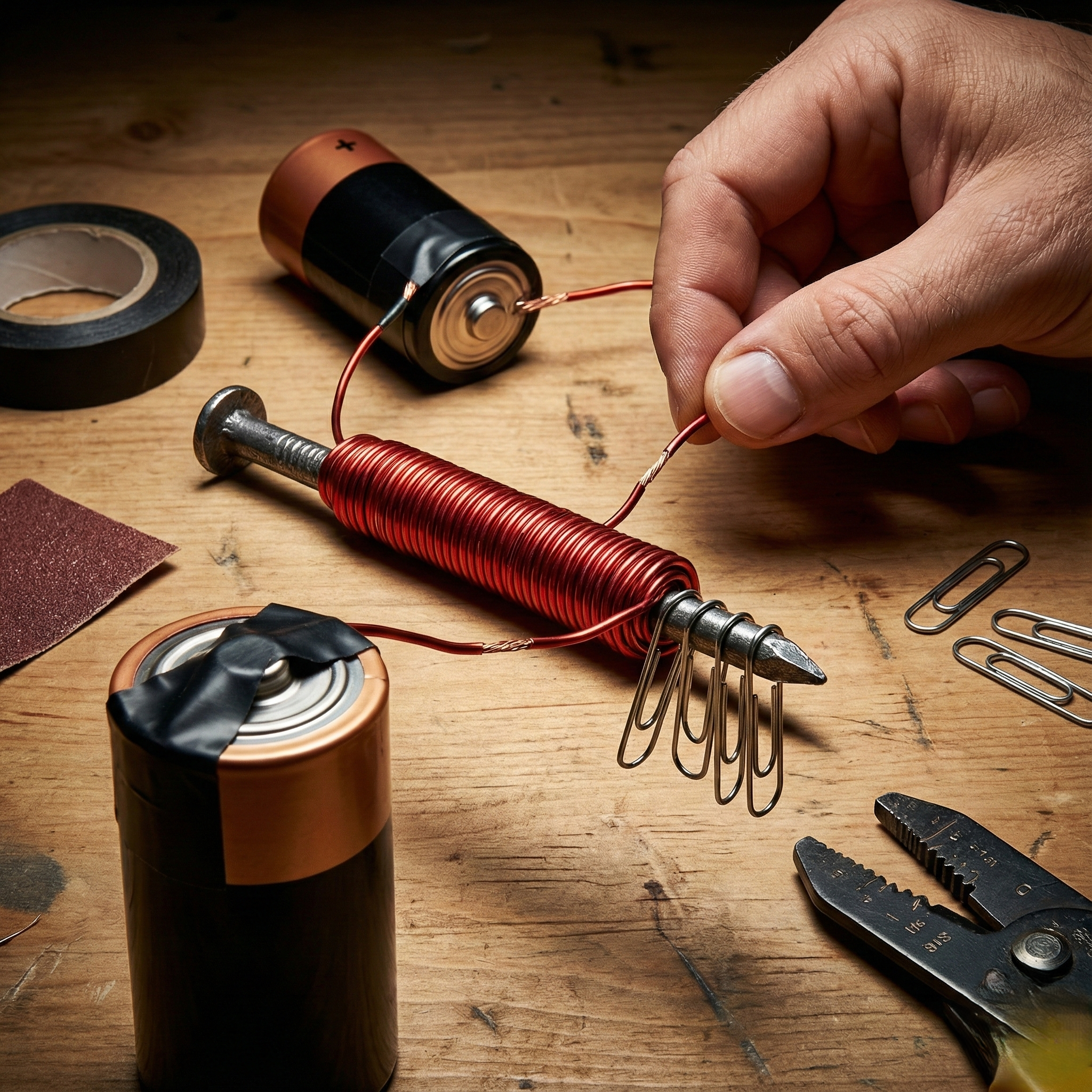
The Electromagnet
This is simple physics experiment to do with kids. It’s hands-on science that teaches real electrical principles that are used in electrical motors all around us.
The Experiment: Wrap copper wire around a large iron nail. Connect ends to a battery. Pick up paperclips. The Lesson: How electricity creates magnetic fields. This is how every motor in your house works. The full step by step instructions below.

1. The goods List
You likely have most of this in your kitchen draw, basement or garage, but the wire type matters.
- A Lead Pencil: A standard soft lead school pencil works.
-
A Large Iron Nail: 3 inches or longer. (Avoid aluminum or galvanized if possible; plain steel/iron works best).
-
Copper Wire: It must be insulated.
-
Best: “Magnet wire” (thin copper wire with a thin enamel coating).
-
Good: Thin standard wire (22 gauge) with plastic casing (strip off the ends).
-
Bad: Bare copper wire (this will just short out the battery).
-
-
Battery: A standard D-cell battery works best (holds more juice, easier to hold).
-
Electrical Tape: To hold the wire to the battery terminals.
-
Paperclips: For testing the magnet (the magic!).
2. The Experiment (Step-by-Step)
Preparation (Dad duty):
-
Strip about 1 inch of insulation off both ends of the copper wire so the bare metal is exposed. (If using magnet wire, sand the tips until they are shiny gold/copper).
-
Leave about 8 inches of wire loose at one end, then start wrapping the wire around the nail.
-
The Wrap: Wrap it tight and neat. The more turns, the stronger the magnet. Try to get 50+ wraps. Do not overlap the wire haphazardly; spiral it down the nail.
-
Leave another 8 inches loose at the other end.
The “Action” (For the kid):
-
Safety Check: Tell your child, “When we connect this, the wire is going to get warm. We only hold it for 10 seconds at a time.”
-
Tape one end of the wire to the negative side of the battery.
-
Have your child hold the handle of the nail and hover it over the paperclips—nothing happens.
-
The Magic Moment: Have your child touch the other wire end to the positive side of the battery.
-
Boom. The nail is now a magnet. Pick up the paperclips.
-
The Drop: Disconnect the wire from the battery. The paperclips will fall instantly.
The Why
Nature usually keeps electricity and magnetism separate. But when we twist electricity in circles (the coil), it creates a magnetic force. The nail concentrates that force.
You know how magnets push away from each other if you hold them the wrong way? A motor is just a giant electromagnet like this one that turns on and pushes against another magnet. Then it turns off, spins, turns on, and pushes again. It pushes itself in circles thousands of times a minute. That spinning pushing force is what turns the wheels of a toy car, the blades of a fan, or the mixer in the kitchen.
Bonus info
Since you have the batteries out, you can extend this lesson by seeing if wrapping the wire more times (100 wraps vs 50 wraps) allows you to pick up more paperclips. (Spoiler: It does). This is exactly the same way we control voltage inside a transformer.
If you have questions or need help with electrical work in the Huntsville area, visit us at huntsvillewireandhome.com or give us a call. We’re here to help.