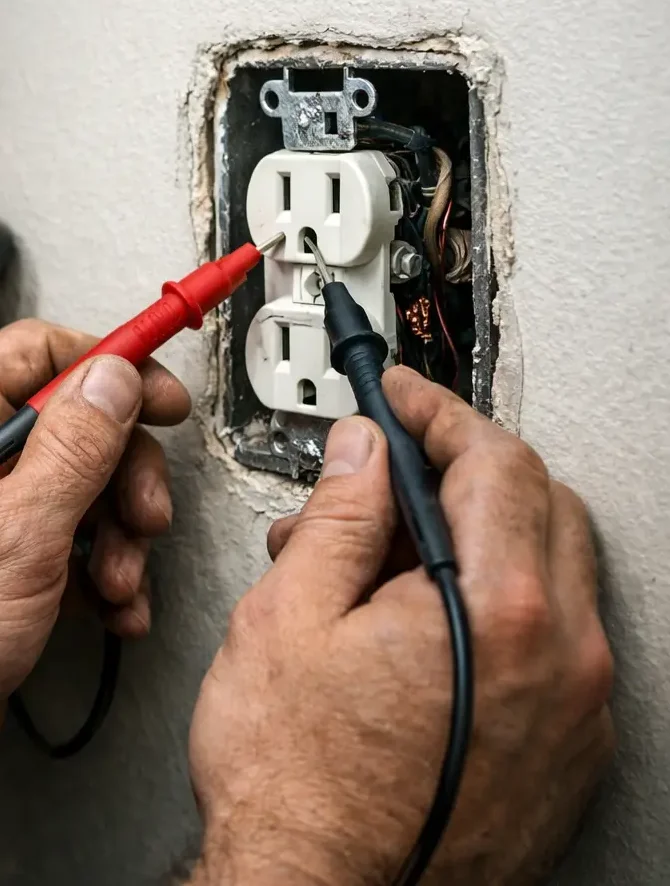
You walk into the kitchen, plug in the coffee maker, and nothing happens. Then you try the outlet by the island. Dead too. The panel looks normal, no breaker is tripped, and now you are stuck wondering why the outlets not working but breaker fine situation keeps happening in your house. This is one of the most common service calls we see, and the cause is usually simpler than homeowners expect, but not always safer.
The main thing to understand is this: a breaker only tells you part of the story. Power can be lost downstream from the panel for several reasons, including a tripped GFCI, a failed device, a loose connection, or a hidden wiring problem. Some of those are minor. Some are early warning signs of heat damage inside the wall.
Why outlets stop working when the breaker looks fine
A breaker protects a circuit from overcurrent. It does not guarantee that every receptacle on that circuit is still getting power. If one device upstream fails, everything fed through it can go dead while the breaker stays set.
That is why this problem often shows up in clusters. Maybe two bathroom outlets stop working. Maybe part of a garage wall goes dead. Maybe the dining room receptacles are out, but the lights still work. That pattern usually points to a branch circuit issue, not a bad panel.
In the field, the most common causes are usually one of four things. A GFCI has tripped somewhere you did not think to look. A receptacle has failed internally. A backstabbed or loose wire connection has opened up. Or a breaker appears fine but has actually failed to reset fully and needs closer testing.
First checks when outlets not working but breaker fine
Start with the simple checks that do not put you into live electrical work.
Look for a tripped GFCI
This is the big one. A bathroom, garage, laundry, exterior, kitchen, or basement GFCI can protect other standard outlets further down the line. Homeowners are often surprised when a garage GFCI knocks out a patio outlet, or a bathroom GFCI affects a bedroom wall on the other side of the house because somebody wired it that way years ago.
Press the test and reset buttons on any GFCI receptacles you can find. Do not just check the room with the dead outlet. Check nearby rooms too. In older homes around Huntsville, Madison, and Harvest, we regularly find circuits routed in ways that make no sense until you trace them out.
Check the breaker the right way
A breaker can look on when it is actually sitting in a tripped middle position. Turn the suspect breaker fully off, then firmly back on. If it trips again right away, stop there. That means there is an actual fault or overloaded condition that needs diagnosis.
If it resets and the outlets still do not work, that does not clear the breaker completely. Some breakers fail mechanically or lose output on one side. It is not the most common failure, but it happens.
Check whether the problem is one outlet or several
If one receptacle is dead but the next one works, the failed device itself may be the issue. If several outlets are out together, the problem is often upstream. That upstream point may be a GFCI, a loose connection, or a damaged receptacle feeding the rest.
Pay attention to what else is on the circuit. If lights, fans, or smoke alarms are also acting strange, that changes the diagnosis.
What usually causes dead outlets
Tripped GFCI protection
GFCIs trip for good reasons and bad ones. Sometimes they catch real leakage current from a damp exterior receptacle or a failing appliance. Other times they nuisance trip because the device is old and worn out. A GFCI that will not reset may be protecting a fault, or it may simply be bad.
This matters because a bad GFCI does not always announce itself dramatically. It can just sit there with no reset, taking a string of downstream outlets with it.
Failed receptacle
Receptacles wear out. Plugs get loose, internal contacts weaken, and heat can damage the device over time. In kitchens, garages, and workshops, repeated heavy use speeds that up. Space heaters, air fryers, microwave ovens, and garage refrigerators are rough on tired devices.
A failed receptacle can kill power to itself and any outlets fed through it. This is especially common where wires were pushed into backstab connections instead of being landed under side screws or on proper pressure plates.
Loose or burned connection
This is the one electricians take seriously. A loose splice or weak termination can arc, build heat, and eventually open the circuit. Sometimes the homeowner notices a dead outlet. Sometimes they noticed warm cover plates, flickering power, or a faint burnt smell a week earlier and did not connect the dots.
When we open a box and find scorched insulation or a brittle device, that is no longer a small inconvenience. That is a repair that needs to be done correctly, with the damaged section evaluated and the circuit checked for any other weak points.
Half-hot or switched outlet confusion
In some homes, especially older ones, part of an outlet may be controlled by a wall switch. If a lamp outlet suddenly seems dead, the switch may have been flipped and forgotten. This is not as common as a GFCI issue, but it still catches people.
Hidden upstream problem
Sometimes the dead outlet is not the real problem location. The actual failure may be at the previous device on the circuit, in an attic junction box, in a garage receptacle, or at a stab-lok style connection somebody buried years ago. That is where tracing skill matters. The bad point is often one box away from where the homeowner first notices the issue.
Signs this is more than a nuisance
If outlets are dead and you also notice flickering lights, intermittent power, buzzing, discoloration, heat, or a smell like hot plastic, treat it as a real electrical problem. The same goes if the affected circuit powers a refrigerator, freezer, sump equipment, medical equipment, or anything that cannot stay down long.
Another red flag is when some outlets work only if a plug is held a certain way, or when a receptacle feels loose in the box. That points to wear, poor termination, or physical damage. It may have been limping along for months before it finally failed.
And if this started after plugging in a space heater, window AC, treadmill, or other heavy load, there is a good chance the circuit was already near its limit. The outlet going dead may be the symptom, not the root cause.
What you can safely do and where to stop
Homeowners can safely check for tripped GFCIs, reset breakers properly, and unplug loads from the affected outlets. You can also note which rooms are affected and whether lights or appliances on the same circuit are acting up. That information helps speed up diagnosis.
What you should not do is start pulling receptacles out of boxes if you are not equipped to verify the circuit is dead and inspect it correctly. A lot of damage is hidden in the back of the box, and a lot of homeowner repairs fail because the visible outlet was replaced while the real issue upstream stayed in place.
This is especially true in older homes, remodels with mixed wiring methods, or houses where prior work was done by somebody who treated electrical boxes like a place to hide problems. We see that all the time.
How an electrician diagnoses it
A proper diagnosis is not guesswork and it is not a parts cannon. It starts by identifying the dead section of the circuit, confirming whether power is present at the breaker, and tracing where voltage is lost. From there, the electrician checks GFCI protection, line and load orientation, failed devices, open neutrals, and overheated connections.
Sometimes the repair is straightforward. Replace a failed GFCI, remake a bad splice, replace a burned receptacle, and test the full branch circuit. Other times the repair grows because the dead outlet uncovered a larger issue like overloaded kitchen circuits, aging backstabbed devices throughout the house, or panel problems that were not obvious at first glance.
That is why honest diagnosis matters. You do not need a commissioned salesperson turning one dead outlet into a dramatic upsell. You do need somebody who can tell the difference between a simple device failure and a circuit that has been running hot for years.
When to call right away
Call promptly if the outlet stopped working after a pop, spark, or burning smell. Call if multiple rooms are affected, if a GFCI will not reset, if the breaker trips repeatedly, or if the dead outlet serves a critical appliance. Call sooner rather than later if this is happening in an older home or one with a history of handyman electrical work.
For homeowners in Huntsville, Madison, and Harvest, this is the kind of problem that usually gets solved faster when the person diagnosing it is the same person doing the repair. That is how Huntsville Wire and Home approaches service calls – find the actual fault, explain it plainly, and fix it to code without turning a straightforward repair into theater.
A dead outlet with a fine-looking breaker might be a quick fix, or it might be your house giving you an early warning. Either way, the smart move is to treat the symptom seriously before a nuisance turns into heat damage inside the wall.